
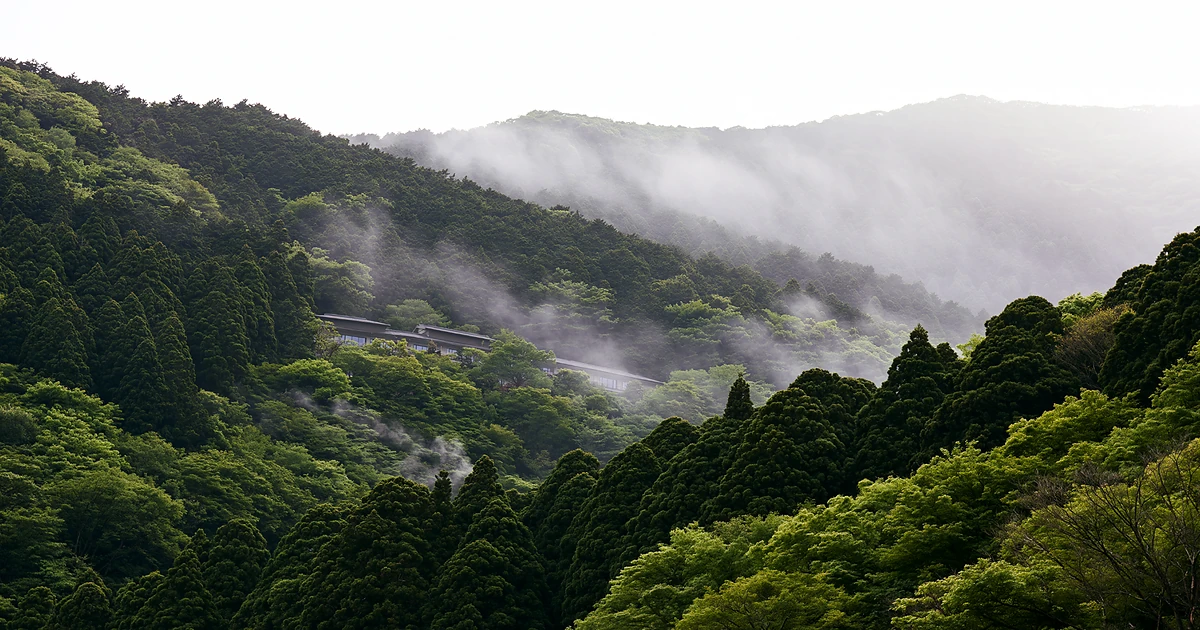
A volcanic caldera, ninety minutes from Shinjuku — where Japan begins to slow down.
Hakone is the first place most foreign travelers learn what Japan means by slow.
It is not the slowness of a quiet temple at dusk, or of an empty train carriage at midnight. It is the slowness of a region whose entire purpose, for several centuries, has been the soft business of stopping. Travelers crossed these mountains on foot in the Edo period. Diplomats and industrialists later built villas in the cooler air of its higher slopes. The mountain railway that climbs from the gateway town to the upper villages was engineered, in part, to make this slowness reachable for anyone.
Today, that history is what remains useful. Hakone sits ninety minutes from Shinjuku by reserved-seat express, inside an active volcanic caldera, surrounded by mountain forest, dotted with many distinct hot spring areas. It is one of the few onsen regions in Japan that a foreign traveler can reach in a single morning, with luggage, in any season, and find — by evening — a private bath, a kaiseki dinner served in a quiet room, and a view of cedar slopes turning gold or white outside the paper screen.
But Hakone also requires care. It is famous, and famous places are uneven. Some hotels are large and overrun. Some districts feel less like a mountain town than a busy stop along a sightseeing route. Some ryokan are extraordinary; others are simply expensive. This guide is not an attempt to list everything in Hakone. It is an attempt to make the choices clearer.
Stay Notes
Best for: First-time ryokan travelers, couples, honeymooners, Tokyo-based itineraries, travelers without a rental car.
Not ideal for: Same-day trippers, travelers seeking complete remoteness, those expecting hotel-style anonymity.
Private onsen: Many premium Hakone ryokan offer in-room or reservable private baths. Configurations vary considerably by property and room category — confirm before booking.
Access: Approximately 85–90 minutes from Shinjuku to Hakone-Yumoto by Odakyu Romancecar. Final transit to your specific ryokan adds 15–60 minutes depending on area.
Meals: Most quiet luxury ryokan plans include dinner and breakfast. Some platforms list room-only rates that look attractive but exclude the kaiseki experience that defines a real ryokan stay.
Typical price: Approachable Luxury through Once-in-a-Lifetime, depending on the property and season.
Last verified: May 2026.
A Region Made of Pieces
Hakone is not a single town. It is a layered region that sits inside the rim of an old volcanic caldera, divided by ridges and valleys into several smaller districts, each with its own atmosphere and its own answer to what a quiet stay should feel like.
For a foreign traveler, choosing Hakone well means choosing the right piece of it.
Hakone-Yumoto, at the lowest elevation, is where the trains arrive. It is the practical gateway: shops, sweet stores, luggage forwarding services, the rush of day-trippers and the steady current of new arrivals. Some excellent ryokan exist around Yumoto, particularly along the river south of the station, but the area itself is where Hakone is busiest. Choose Yumoto when convenience matters more than stillness.
Tonosawa sits a few minutes upstream from Yumoto, in a narrower section of the valley. The ryokan here are tucked into slopes and bridges, the river is closer, and the noise of the station fades quickly. For a first high-end stay in Hakone, Tonosawa often does what newer travelers actually want: it feels secluded without being remote.
Miyanoshita carries the trace of an older Japan. This is the area associated with the historic resort hotels, the foreign visitors of the early twentieth century, and the wood-and-stone architecture of that period. Travelers who care about atmosphere over novelty often find Miyanoshita more moving than the higher resort districts.
Gora is where Hakone becomes a district of villas. Higher up the mountain, reached by the switchback railway from Yumoto, Gora gathers some of the most considered ryokan in the region — old estates and contemporary minimalist properties, often near each other on the same slope. The pace here is slower, the gardens more present, the sense of arrival sharper. The trade is access. Most Gora ryokan require a final transfer by shuttle or taxi from the station, and the roads climb steeply in winter.
Sengokuhara opens onto a high plateau on the western edge of the caldera. The air is cooler, the sightlines longer, the visitor count lower. Pampas grass fields, museums, and forested ryokan define the area. On clear days, this is where a traveler may be able to bathe with Mt. Fuji visible through a window. Sengokuhara is where the silence the rest of Hakone occasionally lacks is most reliably found — but it is also where access requires the most planning.
Lake Ashi, at the southern edge of the region, is a different category. Cedar avenues, shrine gates rising from the water, and on the right morning, a clean view of Fuji across the surface of the lake. It is sightseeing terrain more than ryokan terrain; the inns nearer the lake itself sometimes feel oriented toward the view rather than toward the bath. Choose Ashi for the scenery; choose elsewhere for the slower interior of a stay.
Three Ways to Stay
The luxury ryokan of Hakone fall into three distinct types, and the difference matters more than price.
Heritage Luxury describes ryokan where the building itself is part of what you are paying for. These are properties with architectural lineage — sometimes a former villa, sometimes a structure preserved across generations, often built in the sukiya style that emerged from Japan’s tea-house tradition. The proportions are correct because they follow ratios established centuries ago. The materials are honest. The garden is not decorative but compositional. A heritage ryokan should not simply be old; it should be old and still graceful.
This is the kind of stay where, on the second morning, you find yourself sitting in front of the tokonoma alcove without quite knowing how long you have been there. It is the strongest format for travelers who want the building itself to be part of Japan’s cultural landscape.
Modern Quiet Luxury describes a different idea — newer ryokan, often built since 2000, that draw on traditional Japanese sensibilities while using contemporary materials and engineering. Concrete in conversation with cedar. Large glass walls onto small gardens. In-room baths, restrained dining, fewer than twenty rooms, adult-only service. These ryokan tend to be more straightforward to book from abroad, more predictable in comfort, and clearer in their treatment of foreign guests. For honeymooners, couples concerned about public bathing, or travelers booking a first ryokan with limited tolerance for surprise, this is often the right starting category.
The best modern Hakone ryokan are not lesser experiences than heritage ones. They are different experiences, with different strengths.
Rustic Heritage describes a third category that requires honesty. Some Hakone-area properties — older inns, kominka-style buildings, properties of genuine cultural interest — are not quite suited to a foreign luxury traveler. They may have limited English support, cash-only payment, narrow stairways, seasonal cold, or service rhythms that assume Japanese fluency. These places have their own kind of value, and we write about some of them in our Field Notes as part of Japan’s wider lodging culture. But we do not list them as ryokan to book. The promise of this site is a stay without regret. A rustic heritage property can be culturally fascinating and still produce regret in the wrong traveler.
Choosing well in Hakone often means choosing between Heritage Luxury and Modern Quiet Luxury, and being honest about which one fits the trip you are actually taking.
The Water
Hakone’s water comes from a volcanic landscape that has been quietly rearranging itself for hundreds of thousands of years. The character of the bath you sit in tonight is determined, in the most literal way, by the geology beneath the building.
Around Owakudani, the active crater on the northeast slope, the water turns sulfurous and slightly acidic, milky-white in the bath, distinctive in smell, and long appreciated in Japan for its distinctive mineral character. Several ryokan a short distance from the crater pipe these waters down for use in their baths, which means visitors can experience Owakudani-class sulfur water even in periods when the crater itself is restricted to visitors.
Around Yumoto, where the river valley narrows, the chemistry shifts to soft alkaline simple springs — gentler, barely scented, and often described as having a silky quality on the skin. These have been the waters of Hakone for a thousand years; they are what made the region a hot spring town in the first place.
In Sengokuhara, the waters vary by ryokan, but the consistent texture is quietude. Some properties draw from sulfur sources, others from local springs, still others heat their own.
Foreign travelers do not need to memorize the chemistry. They do need to know that the waters of Yumoto are not the waters of Owakudani, and that choosing your ryokan with the spring in mind — not just the room or the meal — meaningfully changes the experience.
The Final Mile
A ryokan is only as restful as the last hour before arrival. This is true everywhere, but it is especially true in Hakone, where most premium properties sit some distance from the gateway station, and where the final transit segment is often where foreign travelers find themselves most uncertain.
The standard route from Tokyo is the Odakyu Romancecar from Shinjuku to Hakone-Yumoto, eighty-five minutes, reserved seats, no transfers. From Yumoto, three things can happen.
If your ryokan is in Yumoto or Tonosawa, a short taxi or shuttle handles the rest. If your ryokan is in Gora or further uphill, the Hakone Tozan Railway covers the climb — a forty-minute journey through three switchback reversal points, one of the few mountain railways of its kind in Japan, and the reason a distance that looks short on a map takes the time it does. From Gora, a final taxi or ryokan shuttle is usually required. If your ryokan is in Sengokuhara or near Lake Ashi, the picture is more complicated, and the simplest answer is almost always to confirm with the ryokan in advance whether they offer a station pickup.
A practical note from a civil engineering perspective: the road from Hakone-Yumoto toward the upper villages climbs steadily through repeated curves. In winter, even light snow can make the final approach more difficult than it appears on a map. Most ryokan shuttles are used to these conditions; many visiting drivers are not.
The most reliable approach, for nearly all travelers, is to forward large luggage from your Tokyo hotel to the ryokan via takkyubin one day before arrival, then travel light by train and shuttle the day of. This is the most quietly transformative travel habit in Japan — and the most underused by foreign visitors.
Plan to arrive at your ryokan between four and five in the afternoon. Dinner is typically served at six or six-thirty. Arriving with time to bathe, change into the yukata the ryokan has prepared, and let the place’s rhythm reach you is part of the experience itself, not the preface to it.
The Year in Hakone
The traditional answer is autumn — late October to mid-November — when the foliage on the slopes of the caldera turns red and gold. This is the most photographed Hakone, and the most photographed for a reason. It is also the most crowded; weekend reservations during peak foliage often need to be made three months ahead.
Less obvious, and quieter, are the alternatives. Early February to mid-March, while still cold, brings plum blossoms and the first hint of warmth, with significantly fewer visitors and lower rates — and the hot baths feel particularly meaningful when the air outside is sharp. Mid-May to early June, after the cherry blossom peak elsewhere in Japan but before the rainy season, offers fresh greenery, comfortable temperatures, and the relative quiet of a mid-season window. September, after the worst of the summer humidity but before the autumn foliage reaches the area, provides another underused window — though Mt. Fuji views always depend on weather, and clearer winter air often gives the best chance.
Periods to plan around carefully include Golden Week, the late April to early May holiday period, the Obon period in mid-August, and the New Year season — all of which see Hakone ryokan booked solid at significantly elevated rates.
There is no single best season. The right season depends on what you want Hakone to become. A soft introduction. A mountain retreat. A private bath in winter air. A quiet pause between two halves of a longer Japan trip.
One last seasonal note: Hakone is mountain country, and mountain weather has its own logic. Even in shoulder seasons — late November, early March, sometimes into April — snow can reach the upper villages without warning. For any visit between November and March, pack as you would for actual winter: warm layers, shoes that handle wet or icy paths, and the quiet assumption that the slopes around your ryokan may not match the weather you left in Tokyo.
Fuko Notes
Quietness: Strong in Tonosawa, the quieter pockets of Gora, and most of Sengokuhara. More mixed around Hakone-Yumoto and the lake.
Architecture: Distinctive across the region. Hakone holds heritage estates, modern minimalist retreats, and forested villas in close proximity, which is unusual in a single onsen region.
Water: Varied and regionally specific. The strongest stays are at ryokan that explain their spring source clearly.
Approach: Good from Tokyo, but the final transfer matters more than the train ride. Luggage logistics, shuttle timing, and arrival time before dinner deserve real attention.
Foreign-Friendly: Generally stronger than most rural onsen regions. Still varies by individual ryokan.
Value: Highly property-dependent. Hakone has some of the most considered luxury ryokan in Japan, and also a number of famous properties whose reputation outpaces what they currently deliver.
How We Would Choose
For a first quiet ryokan stay in Hakone, the question is not which inn is most famous. The question is what kind of quiet you actually want.
If you want heritage and architecture, look toward the older estates and preserved buildings of Gora and Miyanoshita.
If you want privacy and ease, look for modern ryokan with in-room onsen and clear English-language booking flows — these are scattered across Gora, Tonosawa, and Sengokuhara.
If you want an honest kaiseki experience without the larger luxury infrastructure, look for smaller ryokan with strong individual reputations rather than larger resort-style properties.
If you want the simplest arrival, do not ignore location. A beautiful ryokan deep in Sengokuhara becomes stressful if the final approach is unclear. A graceful ryokan in Tonosawa, fifteen minutes from the gateway station with a confirmed shuttle, often produces a more genuinely restful stay than a more famous property whose access remains uncertain until you arrive.
The best Hakone stay, for most foreign travelers, is not the most famous one. It is the one where the room, the bath, the meal, the access, and the pace of the trip all match.
Before You Decide
For any Hakone ryokan you are considering, confirm five things directly before booking:
Whether dinner and breakfast are included in the plan. Whether the private onsen, if mentioned, is in-room or reservable. Whether the bath uses actual hot spring water — some beautifully presented room baths use heated municipal water and are not, technically, onsen. How to reach the property with luggage, and whether shuttle service exists. Whether the cancellation policy aligns with the way you actually book travel.
For higher-tier rooms, particularly suites or rooms with private outdoor baths, the same property can offer dramatically different experiences. The room category matters as much as the property.
If the stay is for a honeymoon, an anniversary, or any occasion where the wrong choice will be remembered for the rest of the trip, contact the ryokan directly before booking. The best ryokan in Hakone — like the best ryokan anywhere in Japan — respond to careful, specific questions with care.
Related Reading
The Architecture of Quiet — Why Japan’s best ryokan feel the way they do
Selected Ryokan in Hakone — Heritage, water, and quiet, evaluated property by property
Private Onsen in Hakone — A practical guide for couples, first-time visitors, and tattooed travelers
Getting to Hakone Without Stress — The full route from Tokyo
Reading a Ryokan — What to notice on your first stay
Hakone is not Japan’s most hidden onsen destination, and it does not need to be. Its strength is different: a traveler can leave Tokyo in the morning and, by evening, be in a private bath, looking out at a slope of cedar trees turning the color of rust, listening to the small sounds a ryokan makes when it is doing its work properly.
Chosen carelessly, Hakone can feel like a stop on a tour route. Chosen with attention, it becomes the doorway through which the rest of Japan opens.
May your first quiet stay be a good one.
— Fuko