
A field note on why Japan’s best ryokan feel calm before anyone says a word.
A good ryokan does not become quiet because no one is speaking.
It becomes quiet because the building has already asked the body to slow down.
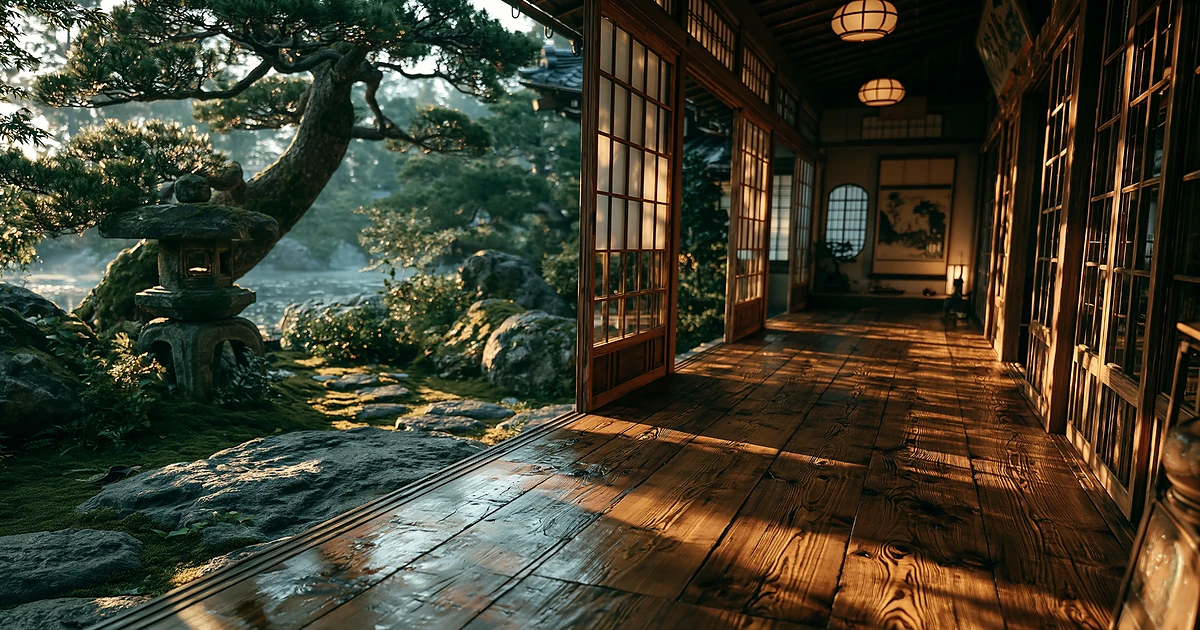
Before the bath, before dinner, before the first cup of tea, the architecture has begun its work: a lower ceiling than you expected, the smell of cedar after rain, a turn in the corridor that hides the next room from view, the cool of stone giving way to polished wood under bare feet.
By the time you reach your room, something has already happened — though you may not yet be able to say exactly what.
In Japan’s best ryokan, quiet is not an atmosphere added at the end.
It is built into the sequence.
This Field Note is about how that sequence works, what to look for, and why it matters when choosing where to stay.
Quiet Is Designed
Foreign travelers often describe a good ryokan as peaceful or calm, but those words can make the experience sound accidental.
It is not accidental.
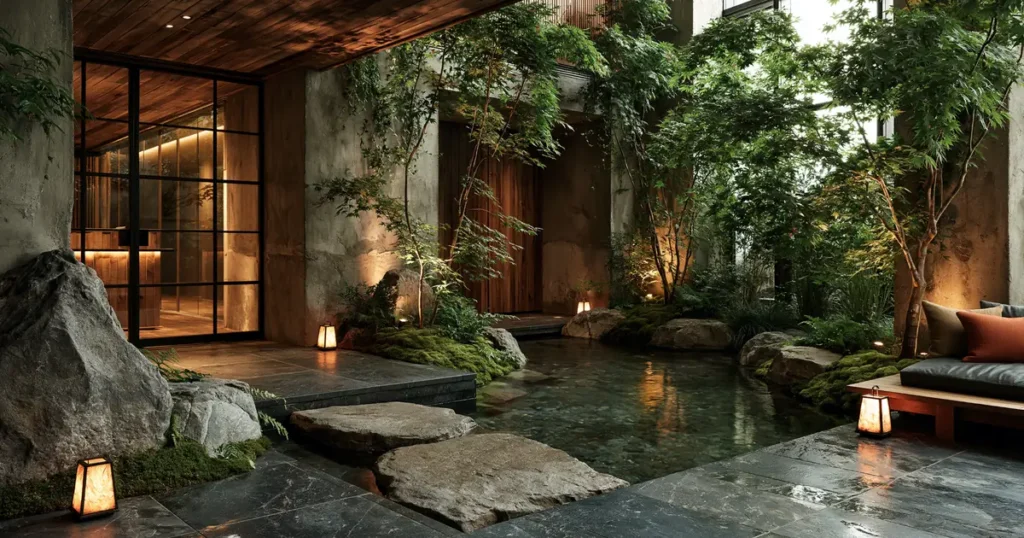
The calmness of a ryokan is usually the result of many small decisions: how the entrance is placed, how sound is absorbed, how far the room sits from the road, how the garden is framed, how the bath is reached, and how the guest is moved from outside time into inside time.
A hotel often begins with efficiency.
The lobby is designed to process you. Check-in happens at a counter. A key is handed over. The elevator takes you upward. The room is the destination.
A ryokan begins differently.
The guest is not simply processed. The guest is slowed.
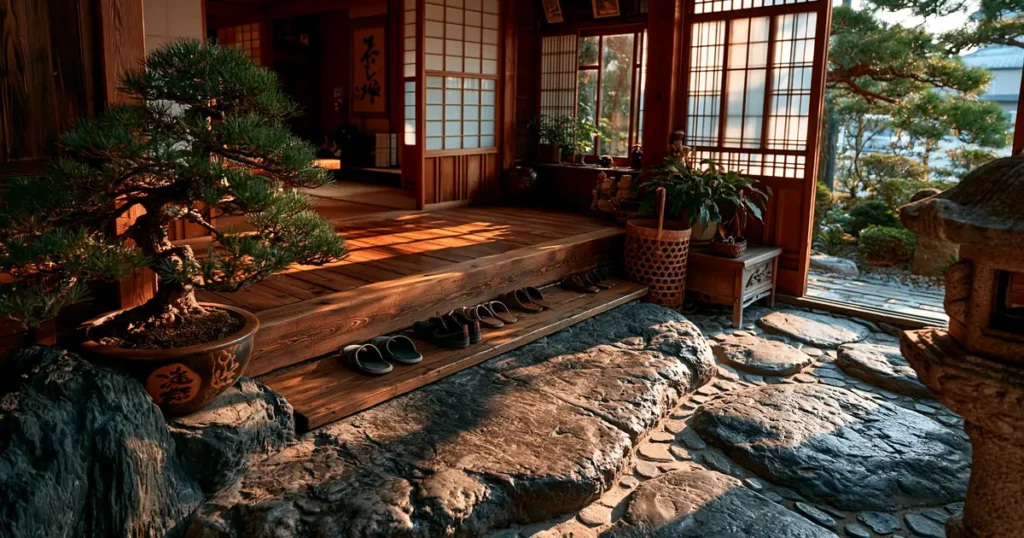
Shoes are removed.
The floor level changes.
A staff member may invite you to sit.
Tea may arrive before any explanation feels necessary.
A garden may appear before the room does.
This sequence is not decoration. It is part of the stay.
A ryokan does not need to announce its quiet.
The building does the announcing.
The First Threshold
The first important architectural moment in a ryokan is often not the room.
It is the threshold.
Japanese architecture treats the change from outside to inside seriously. The entrance is not just a door. It is a small ritual space where the body changes state.
Notice what happens at a good entrance.
Shoes come off.
The floor rises by a step.
Stone gives way to wood.
The sound underfoot changes.
The pace of walking changes almost automatically.
Old wood and tatami do not reward fast walking. They ask for softer steps.
There is also, in many good ryokan, a moment when the building is hidden from you on purpose. A wall, a screen, a turn in the path, a shadowed entry, a small garden that appears before the main space does.
You do not see everything at once.
That matters.
A place that reveals everything immediately often feels commercial.
A place that reveals itself slowly feels private.
The first threshold teaches the guest how to behave.
Not by instruction.
By atmosphere.
If you arrive at a ryokan and feel a brief moment of pause — Where should I go? Should I wait? Should I remove my shoes here? — that is not always a design failure.
Sometimes, that pause is the beginning of the stay.
Proportion: The Calm of Correct Scale
One reason traditional Japanese spaces feel calm is proportion.
The ceilings are often lower than foreign visitors expect. The openings are measured. Posts, beams, tatami mats, alcoves, and sliding doors create a rhythm of repeated intervals.
The body reads this before the mind explains it.
A room that is too tall can feel exposed.
A room that is too wide can feel empty.
A room that is too decorated can feel restless.
A good ryokan room often does the opposite.
It gives the body enough space to breathe, but not so much space that the guest feels lost inside it.
The proportions of tatami rooms are especially important. Tatami does not behave like ordinary flooring. It organizes the room. It suggests where to sit, where the table belongs, where the futon will be laid, and where the eye should rest.
A simple way to understand this is to sit lower.
After arriving in a ryokan room, sit on the tatami rather than on a chair. Drink the welcome tea from that lower position. Then look around the room again.
The ceiling may suddenly feel more correct.
The window may become a horizon.
The garden may feel larger than the room itself.
This is not coincidence.
Many traditional Japanese rooms are designed around a seated body. Standing in the room gives one reading of the space. Sitting gives another.
The result is not luxury in the Western sense of more.
It is luxury in the Japanese sense of enough.
Enough width.
Enough shadow.
Enough light.
Enough distance between the guest and the outside world.
Materials That Age Quietly
Western luxury often associates quality with shine.
New surfaces.
Polished marble.
Glass.
Brass.
Mirrors.
A ryokan teaches another kind of luxury: materials that age quietly.
Wood, paper, stone, clay, bamboo, plaster, woven grass, and mineral surfaces all change over time. They absorb touch, humidity, light, and season. They do not remain perfect, and that is part of their dignity.
A wooden corridor may darken where guests have walked between the dining room and the bath for decades. At first, it may look like a shadow falling across the floor.
It is not a shadow.
It is the building keeping a record of its guests.
A stone at the entrance may hold rain differently in winter than in summer. A paper screen may glow differently at dawn than in late afternoon. A wooden bench may soften at the edge where hands have rested for years.
This kind of material honesty is difficult to fake.
It is also why some older ryokan feel more peaceful than newer buildings with more expensive finishes.
But there is an important distinction.
Old is not automatically beautiful.
Weathered is not automatically refined.
Historic is not automatically comfortable.
A heritage ryokan should feel cared for, not merely old.
The best buildings carry age without making the guest feel burdened by it. A neglected inn can feel cold, damp, or tired. A well-maintained heritage ryokan feels like a place that has been respected by its owners for as long as the building has existed.
The luxury is in the care, not the age.
The Corridor as a Slow Instrument
In many Western hotels, the corridor is leftover space.
It is the part you walk through to reach the room you paid for.
In a good ryokan, the corridor can be part of what you paid for.
A corridor may turn slightly before reaching the room. It may open briefly toward an inner garden. It may narrow, lower, or darken before widening again. It may use a change in floor material to slow the feet.
These are small gestures, but they matter.
A straight, bright, endless corridor tells the body to move quickly.
A curved, shaded corridor tells the body to pay attention.
Some ryokan use this beautifully. The room is not delivered immediately. It is approached.
The guest passes through a sequence of partial views: a stone lantern glimpsed through a side opening, a tree trunk framed by a small window, a courtyard appearing for a few seconds and disappearing again, a sliding door left slightly open onto a patch of green.
By the time the guest reaches the room, arrival has already happened.
The room is not the beginning of the stay.
It is the result of the approach.
This is also why a ryokan that looks small on a map can feel large on foot. The experience of a place is shaped not only by size, but by the number of quiet moments it gives you between one space and the next.
Gardens Are Not Decoration
In a good ryokan, the garden outside your window is not simply something pretty.
It is a timekeeping device.
Moss shows moisture.
Pine shows age.
Maple shows season.
Stone shows stillness.
Water shows movement.
Empty space shows restraint.
A ryokan garden is often not understood at first glance.
On the first evening, a traveler may notice only greenery beyond the window. The next morning, perhaps a stone lantern. In rain, perhaps the way water gathers along the edge of a rock. In winter, perhaps the reason a tree was placed exactly where the eye naturally falls from the futon.
The ryokan may never explain this.
Most good ryokan do not explain everything. They simply arrange the world carefully enough that, if you slow down, you begin to notice.
This is one of the quiet pleasures of a Japanese ryokan: the slow recognition of how much has been placed in your favor without anyone making a performance of it.
A garden beside a ryokan room is not only scenery.
It is the first lesson in staying still long enough to see something for the second time.
Borrowed Scenery and the Sense of Distance
Some ryokan feel calm because they understand not only what is inside the property, but what lies beyond it.
In Japanese garden design, the idea of borrowed scenery — shakkei — uses distant mountains, trees, sky, or landscape as part of the composition.
This is not limited to famous gardens.
A quiet ryokan may borrow a cedar slope, a river valley, a ridge line, the steam from a volcanic hillside, or the sound of rain on surrounding trees.
The building does not try to dominate the landscape. It accepts that the larger scene is already stronger than anything the architect could build.
This is one reason mountain ryokan often feel more complete than urban luxury hotels.
The building is not the whole experience.
The approach road, the valley, the garden, the bath, the meal, and the view all work together.
When this relationship is right, the guest does not feel placed in a resort.
The guest feels placed inside a landscape.
Water as the End of the Architecture
In an onsen ryokan, the bath is not simply an amenity.
It is often the architectural conclusion.
The entrance slows the body.
The corridor narrows attention.
The room receives the guest.
The meal marks the evening.
But the bath completes the transition.
Imagine a winter morning in the upper hills of an onsen region: a small outdoor bath, rough stone at the edge, dark cedar beyond the steam, and the first grey light arriving before the guest is ready to leave the water.
Nothing dramatic needs to happen.
The water holds the body.
The architecture holds the water.
The mountain holds the architecture.
This is the kind of design that requires little explanation. It also cannot be photographed properly. It can only be experienced by being placed inside it.
A private outdoor bath is not automatically good because it is private.
It becomes good when the water, edge, view, sound, steam, and body position have been considered together.
When you research a ryokan with a private bath, ask yourself:
Where does the guest sit?
What can be seen from the bath?
What cannot be seen?
Is the sound of water too loud, or just enough?
Does the bath feel exposed, or held by the architecture?
Does the view calm the body, or distract it?
Some of the most memorable baths in Japan are small, because they are correctly placed.
The water should belong to the architecture, not feel like a luxury feature added after the fact.
This is often the difference between a ryokan that photographs well and a ryokan that stays in the body after you leave.
The Quiet of Good Service
Not all quietness is architectural.
Some of it is operational.
A ryokan can have beautiful buildings and still fail to feel calm if the service rhythm is wrong. If check-in is rushed, dinner is chaotic, staff explanations are unclear, or luggage handling is confusing, the architecture cannot fully rescue the experience.
This matters especially for foreign travelers.
A Japanese guest may already understand the unspoken rhythm of a ryokan: when to bathe, when to change into yukata, how dinner timing works, how to move between room and bath, what is expected at the entrance, and how quietly to behave in shared spaces.
A foreign traveler may not.
For that reason, foreign-friendly quietness is not really about English ability alone. It is about whether the ryokan helps the guest settle into the rhythm without embarrassment.
The best ryokan for a first foreign stay are the ones where the guest never feels watched.
Dinner time is explained gently.
Bath rules are made clear without sounding severe.
Luggage appears in the room without confusion.
Shoes, slippers, yukata, and dining location are explained without making the guest feel foolish.
This kind of service protects the quiet that the building has spent so much effort creating.
It is rarer than it looks.
The Final Mile Is Part of the Design
A ryokan stay does not begin at check-in.
It begins on the final approach.
This is one of the reasons Fuko Onsen Retreats treats access as part of the stay, not as a separate logistical note.
A beautiful ryokan can lose its calm before the guest arrives if the route is unclear, the road is steep, the shuttle time is missed, the luggage is too heavy, or the traveler arrives late for dinner.
In mountain onsen regions, the final mile often matters more than the first ninety minutes from the city.
The train from Tokyo may be simple.
The last taxi, bus, slope, bridge, or shuttle may not be.
This is not a minor detail. It shapes the emotional state of arrival.
A ryokan that is difficult to reach can still be worth it. Many are. But the difficulty must be understood before the guest commits.
Approach is part of architecture because it shapes how the body enters the place.
A calm stay requires a calm arrival.
What to Notice on Your First Ryokan Stay
A first ryokan stay can feel unfamiliar in many ways at once.
You do not need to understand all of it. You only need to notice a few specific things — and the noticing itself becomes part of the pleasure.
Notice the entrance. Does the building slow you down before anyone speaks?
Notice the floor. Where does stone become wood? Where do shoes disappear? Where does the sound of walking change?
Notice the light. Is it bright and flat, or softened by paper, wood, shadow, and garden?
Notice the corridor. Are you being moved directly to a room, or gradually through a sequence of small views?
Notice the window. Is the view simply large, or is it framed?
Notice your tea. It may arrive within a few minutes of entering the room. The cup is usually small. The tea is often warm rather than hot. The sweet beside it is rarely an afterthought.
Notice the bath. Does it feel like part of the room, the garden, and the landscape — or like a feature added to make the room more expensive?
Notice dinner. Does the meal feel like performance, or like pacing?
Notice the morning. A ryokan often reveals itself most clearly after sleep, when the body has stopped comparing it to a hotel.
The first stay does not need to be perfect.
It only needs to teach you how to see.
By the second ryokan, you will see twice as much. By the third, the architecture may become legible to you — and you may begin to recognize the difference between a great ryokan and a famous one.
Fuko Notes
Quietness: The strongest ryokan are quiet before they are silent. Their design slows the guest before service begins.
Architecture: Proportion, materials, thresholds, corridors, gardens, and bath placement matter more than decorative luxury.
Water: A bath should feel integrated into the stay, not attached as a feature.
Approach: The final route to the ryokan is part of the emotional experience. Arrival should not undo the calm the stay is meant to create.
Foreign-Friendly: The best ryokan for foreign travelers explain the rhythm of the stay without making the guest feel outside it.
Value: True ryokan luxury is not larger rooms or higher prices. It is the feeling that every part of the stay has been considered.
Why This Matters When Choosing a Ryokan
Two ryokan may both be expensive.
Two ryokan may both have private baths.
Two ryokan may both serve kaiseki dinner.
But they may not offer the same kind of quiet.
One may be quiet because it is remote.
Another may be quiet because it is small.
Another may be quiet because the building is old and well cared for.
Another may be quiet because the service is restrained.
Another may only look quiet in photographs.
This is why Fuko Onsen Retreats does not choose ryokan by beauty alone.
A beautiful ryokan can still be wrong for a particular traveler.
It may be too difficult to reach.
It may be too formal for a first stay.
It may be too old for someone expecting modern comfort.
It may be too modern for someone seeking architectural depth.
It may be too famous to feel restful.
Choosing well means understanding what kind of quiet you are choosing.
The articles on this site try to help you make that distinction — not by ranking ryokan against each other, but by describing each one carefully enough that you can recognize whether it matches the trip you are actually taking.
Related Reading
Where Tokyo Goes to Rest — A quiet guide to Hakone Onsen for first-time ryokan travelers
Selected Ryokan in Hakone — Heritage, water, and quiet, evaluated property by property
Private Onsen in Hakone — A practical guide for couples, first-time visitors, and tattooed travelers
Getting to Hakone Without Stress — The full route from Tokyo
Reading a Ryokan — What to notice on your first stay
A good ryokan does not ask you to admire it immediately.
It asks you to arrive.
Then to remove your shoes.
Then to sit.
Then to drink the tea.
Then to notice the garden.
Then to hear the water.
Then to let the room become smaller than the world outside, and somehow more complete.
Quiet is not the absence of sound.
It is the presence of care — built into wood, water, light, and time, and waiting patiently for you to arrive and notice it.
— Fuko